Sunday, 19 October 2014

Minor Project: Adjusting the Story to Suit the Intended Atmosphere

Whilst working on my pre-vis, I began to question how I really wanted to present this story. 

Typically, as I go along, I create very simple, one or two panel storyboards to help dictate key shots in my pre-vis. 

The general pattern in these shots was the use of obscure angles, intense close ups and switched focus as a means of obfuscation, and it was from here I had been deriving the suspense and horror of the second act. 

Originally, the second act was driven by various minor plot points and bumps in the road for Franklin to overcome, however, I've come to the conclusion that this may not be the best way of instilling sensations of dread, disbelief and revulsion in the audience. 

Instead, I've decided to employ alternative cinematic techniques in favour of a more visually appealing and overall more impactful animation.

As a result of this, I've chosen to streamline the second act considerably. I felt that certain aspects, such as the failing electrical device and Franklin returning to the hallway, greatly interrupted the gradual build up of tension and suspense from the scenes leading up to this point. This made the misdirection fairly redundant, and ultimately kills the impact of the reveal in the third act. 

I've chosen instead to eliminate these interruptions and focus on the build up. While these story elements were in no way bad, they do very little to contribute to the intended atmosphere of the story. 

The visual aspects of the animation will tell a far better story than an overabundance of plot.

So, how do I plan to achieve this? Through use of visual misdirection, obfuscation and sensory exploitation. 

Below, I've included some examples of cinematic techniques I've drawn influence from.

Opening Sequence to Se7en

The Death of Marion Crane in Psycho

The Opening Credits of Dexter

Disposing of the Body in Shallow Grave

Eraserhead  Trailer
Saturday, 11 October 2014

Minor Project: Franklin Initial Character Development

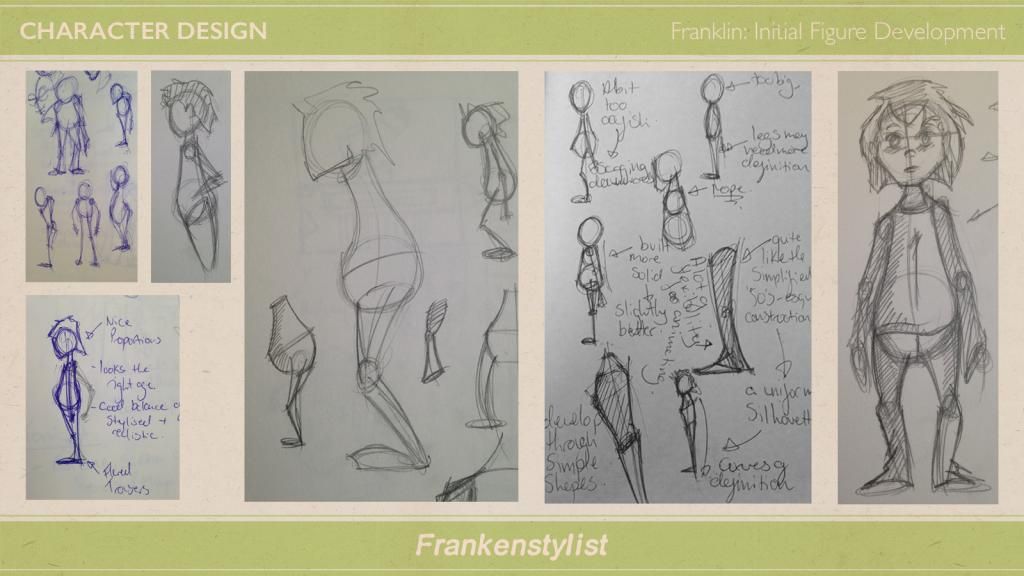
In this post, I've assembled a sample of the design process for Franklin. Its still very early days, but the design appears to be slowly finding its feet.

The first group of images are simple form and construction sketches. A jumping off point for the rest of the design. I wanted Franklin to be a fairly typical child, with his general composure giving him an outward impression of eeriness. I drifted towards the image on the far right and built it up from there.


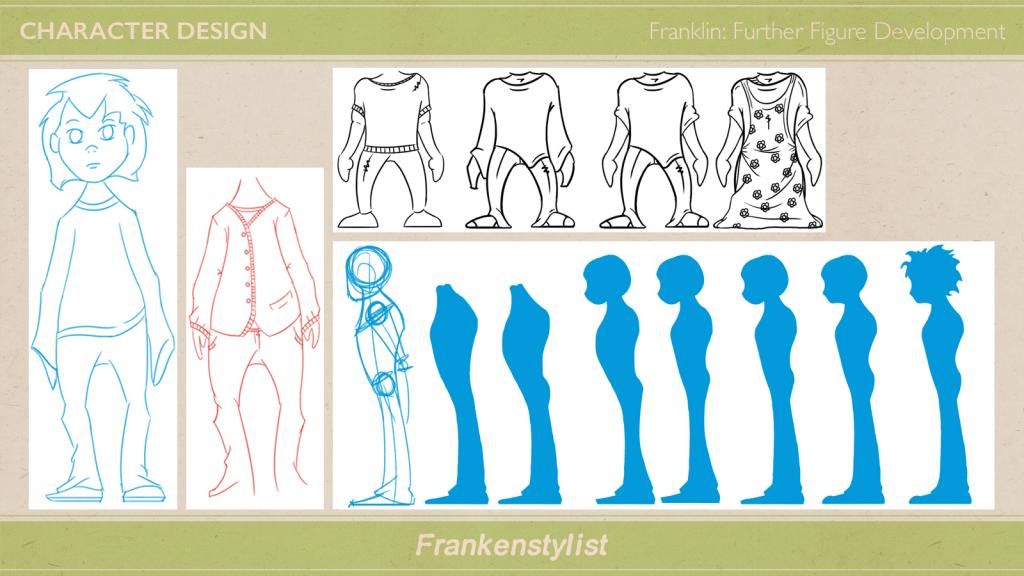
I began to quickly tighten up the form, as seen in the profile silhouettes. I wanted the character to be somewhat stylised and streamlined in his general form, without looking to blatantly odd. Ive also assembled some general outfit variations, adhering to the fashion trends of children in working class families of the 1970s, as well as the addition of an oversized apron for the second act.


I've also attempted to refine the design of Franklin's face. I wanted him to look childlike, but not so young as to look cutesy. I've opted for larger, more spaced out eyes in most of the design, although I'm not sure whether contributes or removes some of the implied menace of the character.


My aim for the character is to have him at least semi-realised by the pitch, and whilst its not looking overly spectacular at the moment, I believe it's possible.


Wednesday, 8 October 2014

Minor Project: Act One, Scene One Pre-Vis

This is the Pre-Vis for the first scene of Act One. The timing is a bit off in places, but the general idea is there.

I'm not sure whether I'm going to use any music in this particular scene, as I think it may ruin some of the 'tumbleweed' comedic elements of the interaction between Franklin and the Delivery Driver.

Any feedback at this early stage is greatly appreciated.

(Also, the scale between characters is insanely iffy, although this won't translate over to the final animation!!!)


Monday, 6 October 2014

Minor Project: 'Franklin' Character Influences

Below is a collection of influential images for the Franklin character.

 I wanted to retain the naivety of the character, so that he's not matured to the point where he can question or see issues with his actions. He is just living impulsively. 

Because of this, I've decided to keep him around the age of 7 or 8 years old. Whilst the images below vary in age group, the aesthetic is still relevant to the character.

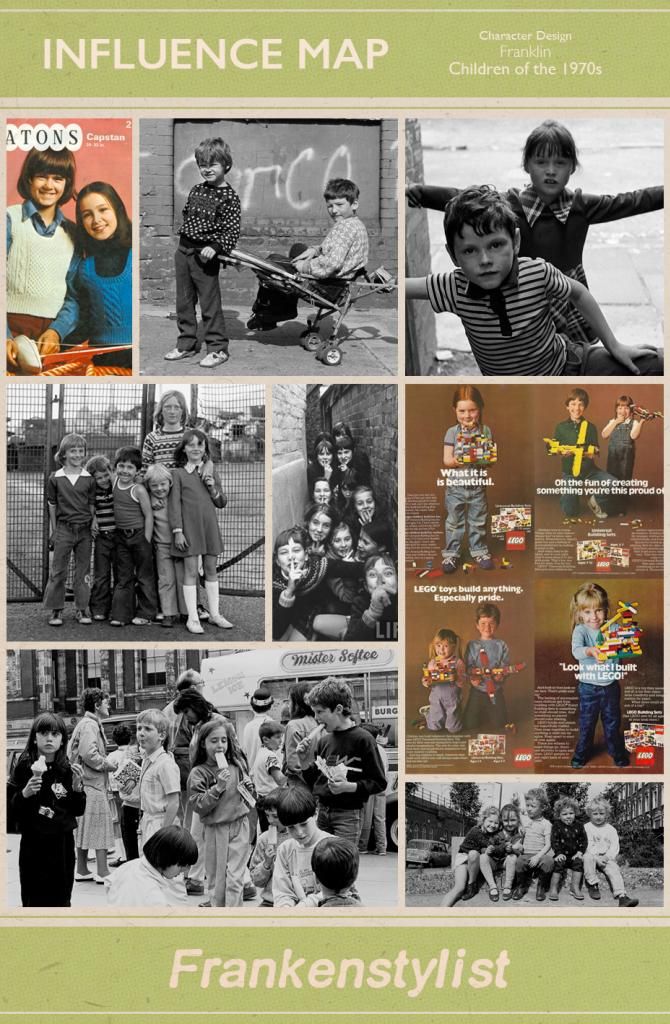
The first influence map depicts children of the 1970s wearing typical clothing and engaging in typical activities of the time. The majority of the images were taken by photographer Colin O'Brien, although I've also included an advertising campaign from the time for Lego. The children in the adverts are not only a similar age to Franklin, but their expressions of accomplishment also resonate with the character and his actions.


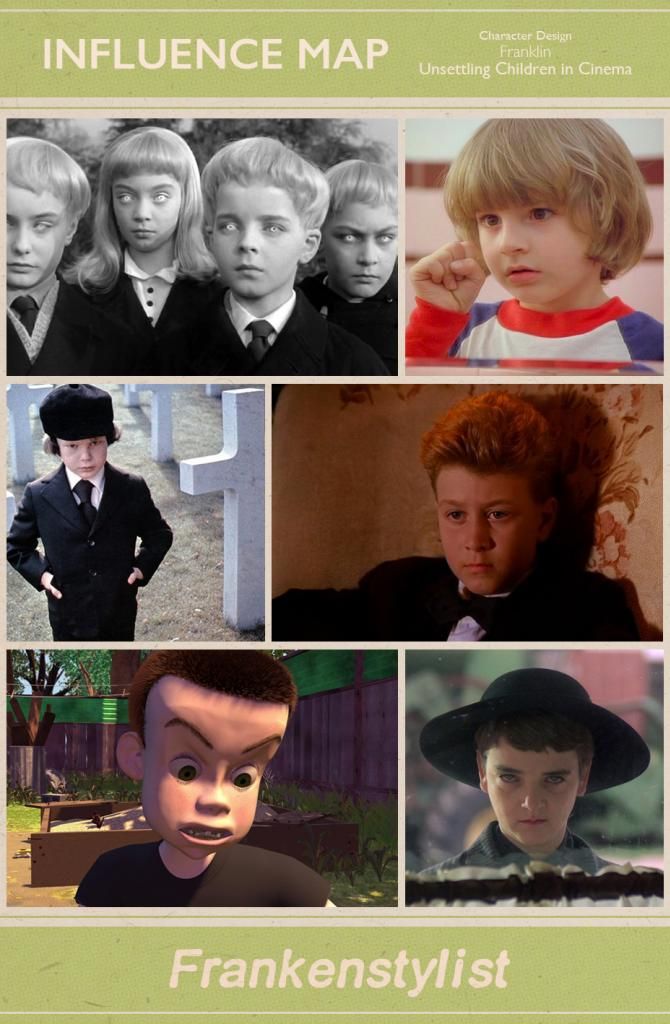
The second influence map depicts particularly unsettling children in cinema. For the majority of the story, Franklin is meant to emit an aura of menace, whilst providing an impression of innocence to the rest of the world. The children in the influence map all provide this impression (with the exception of Sid from Toy Story, who was included as a source of influence for the second act).


Sunday, 5 October 2014

Minor Project: 'Frankenstylist' Screenplay - Draft Four

This is the current draft of the complete revised screenplay for Frankenstylist. There are a number of substantial changes from the original screenplay, although the essence of the piece is very much the same.
This draft is in no way polished, but it is the first time the revised story has been seen in its entirety. I've yet to go through and really tighten the various components up, although this should give you a good idea where the story is going.
I've kept my ongoing notes in this draft as well, which should help explain the reasoning behind some of my choices in this version.

Tuesday, 30 September 2014

Minor Project: Act One Revised Screenplay

As the tone of the animation has shifted dramatically since the original project, I've began to rewrite the screenplay to accommodate this. This is the initial rewrite of Act One, with Acts Two and Three to follow shortly.
A couple of notes about this particular draft; The bulk of interaction is between Franklin and the Delivery Driver, although I've introduced the possibility of both Mother and Father characters. This is to help drive home the feeling of neglect and disfunction from the perspective of Franklin, although this would involve a lot more work for a very, very brief amount of screen time, so I may end up relying on set dressing and other methods of visual storytelling.

FADE IN:

ACT ONE, SCENE ONE

EXT. STREET

ESTABLISHING SHOT: A row of terraced houses. On the horizon, smog rises from the smokestacks of local industry.

A delivery van pulls into frame. Emblazoned on the side is the logo for an animal delivery company.

The van comes to a stop.

A DELIVERY MAN steps out, a box labelled ‘LIVE ANIMAL INSIDE’ under his arm.

He begins to walk along the path, turning through the gate of one house in particular.

The Delivery Man rings the doorbell, turning to look around in disinterested anticipation, gently whistling to himself.

The hefty thud of approaching footsteps can be heard through the door, catching the Delivery Man’s attention.

CUT TO POV of the Delivery Man, looking through the glass window of the front door.

An imposing silhouette gradually fills the space with each accommodating thud.

The door begins to unlock.

Gradually, the door swings open. The Delivery Man is greeted by nothing but a view of the hallway.

PAN DOWN to reveal a young CHILD, about nine-ten years old, peering out hesitantly from behind the front door.

Somewhat confused, the Delivery Man looks past the Child into the house, in search of a more responsible and likely recipient.

After finding nothing, the Delivery Man reluctantly passes a clipboard to the Child. The Child steps out into the doorway.

The Child’s signature reveals his name to be FRANKLIN.

Franklin passes the clipboard back to the Delivery Man.

Cautiously, the Delivery Man passes the box to Franklin, who accepts it with an unsettling expression of vague joy upon his face.

Franklin peers through the holes in the box.

The Delivery Man slowly backs out down the path, Franklin watching him with an expressionless face.

The Delivery Man’s pace increases until he reaches the van.

The van leaves urgently, and Franklin slinks back inside, slowly closing the door behind himself.


ACT ONE, SCENE TWO

INT. HALLWAY

The walls and floor are coated in a gaudy floral pattern. A single, yellow light bulb just about manages to illuminate the hall.

Scattered across the floor are the miscellaneous scraps of a typical family. Footwear, broken toys and unopened post.

Family photographs adorn the walls, Franklin curiously absent in most of them.

Franklin begins to make his way down the hallway, stepping over and around all manner of mess scattered across the carpet, occasionally stumbling along the way.

He reaches the stairs, and begins to ascend.

Halfway up, Franklin pauses, looking into the living room through the wooden bannisters.

In the living room is his FATHER, mindlessly watching television.

His MOTHER is stood at the opposite end of the room, gazing out of the window with a cigarette in hand.

Franklin continues to quietly creep up the stairs.


END of ACT ONE


Minor Project: The Childhoods of Serial Killers

The tone and the setting of the story has changed significantly since my original project, and the characters are going to change to reflect this.

The first significant change is the name of the main character, which has gone from Frankie to Franklin. I found the name Frankie to be a little too cutesy, especially now the overall tone has changed. This slight change should help to shift the initial impression of the character.

The most dramatic alteration is the overall perception of the character. The bleak tone of the setting, and my personal desire to create a far more sinister and foreboding build up to the third act, have resulted in the decision to present Franklin as more of a troubled child  than a little terror.

In my tutorial, Phil and I discussed the various visual methods of implying Franklin's desirable upbringing, family photographs where he is absent, mutilated toys, books of unusual interests, among other things. This led me to research into the childhoods of various serial killers, discovering the subtle things in their lives which, in retrospect, revealed things about their unsavoury futures.

Below is a list of the unconventional personality traits and significant life events of particular serial killers throughout their childhoods.

Ed Gein
  • Shy
  • Strange Mannerisms
  • Random Laughter
  • A Domineering Mother
  • Interest in Animal Carcasses
Jeffery Dahmer
  • Interest in Animals
    • Animal Carcasses
    • Insect Specimens
  • Outcasted
  • Largely Uncommunicative Yet Polite
  • Prior Planning to Commit Certain Acts
  • Repressed Homosexual
  • Loner
  • Simulated Cerebral Palsy and Seizures for Attention
Fred West
  • Incestuous Childhood
  • Taught About Beastiality at a Young Age by His Father
  • Attitude of Father "Do What You Want, Just Don't Get Caught Doing It"
  • Childhood Injuries, Seven Day Coma
  • Arrested in Teens on Molestation Charges
  • Sent Away and Disowned by Family
Dennis Nilson
  • Initially Quiet, Yet Adventurous
  • Quiet and Reserved After Death of Grandfather
  • Seldom Participated in Family Activities
  • Actively Repelled Any Affection from Adults
  • Resented Siblings
I plan on using the information gathered above to inspire the initial perceived personality of Franklin, through a combination of his mannerisms, belongings and elements of the environment design.